Barrie needs about 35 additional buses in its conventional fixed-route fleet if we want public transit to become a practical choice for more daily trips.
This is not a random number. It comes from a preliminary planning model that residents and City staff can examine and test. The proposed Barrie Rapid Network would require 67 buses operating during the weekday peak, plus 14 spare buses, for an 81-bus planning fleet. The City of Barrie’s 2026 budget reports a conventional fleet of 46 buses. The difference is about 35 buses.
Barrie cannot implement an expansion of this scale alone. The project would require substantial provincial and federal funding, secured through a phased implementation plan before major vehicle and facility purchases begin.
The calculation is preliminary because the proposed routes and running times still need professional analysis. It gives Barrie a clear question to investigate: what fleet, facilities and operating budget would be required to provide direct and dependable transit across the city.
Read the full 13-page proposal (PDF)
What I have learned driving across Barrie
I have been driving Uber for about a year and a half, with most of my driving taking place in Barrie. That experience has given me a street-level view of how people move around the city and where the current transit system does not meet their needs.
Many passengers are making routine trips. They are travelling to work, returning home after a shift, going to school, keeping an appointment or buying groceries. Most of my rides carry one passenger, using one vehicle to make a trip that could potentially be served by transit.
Uber becomes expensive when someone needs it several times a week. Yet many passengers feel they have little practical choice. They cannot risk being late for work. They do not want to wait a long time at the end of an evening shift. The transit network may serve both ends of their trip, but an indirect path or the need to transfer between buses can make the total trip too long.
The concern I hear most often is simple: travelling from one part of Barrie to another takes too long.
Why current transit trips take too long
Barrie Transit provides an important service seven days a week. But for many residents, long waits and indirect routes make it too slow to be a dependable first choice.
The City’s 2026 budget overview reports 30-minute service during peak periods. The current Route 8B timetable, for example, shows service every 30 minutes on weekdays and Saturdays but every 60 minutes on Sundays.
For riders, those gaps matter. Arriving just after a bus leaves can add almost half an hour to a weekday trip or almost an hour to a Sunday trip. Missing a connection can add another full wait.
Frequency is only part of the problem. Existing routes cover broad residential areas, which helps keep service within reach of more homes. But routes that turn through many neighbourhoods can make cross-city trips long and indirect.
When transit trips take too long, more people turn to private cars, family members or ride-hailing. That adds more vehicles to the road, while buses caught in the same congestion become less reliable. Breaking that cycle requires a network that maintains local access while making cross-city trips more direct.
Three direct Rapid Lines would form the backbone
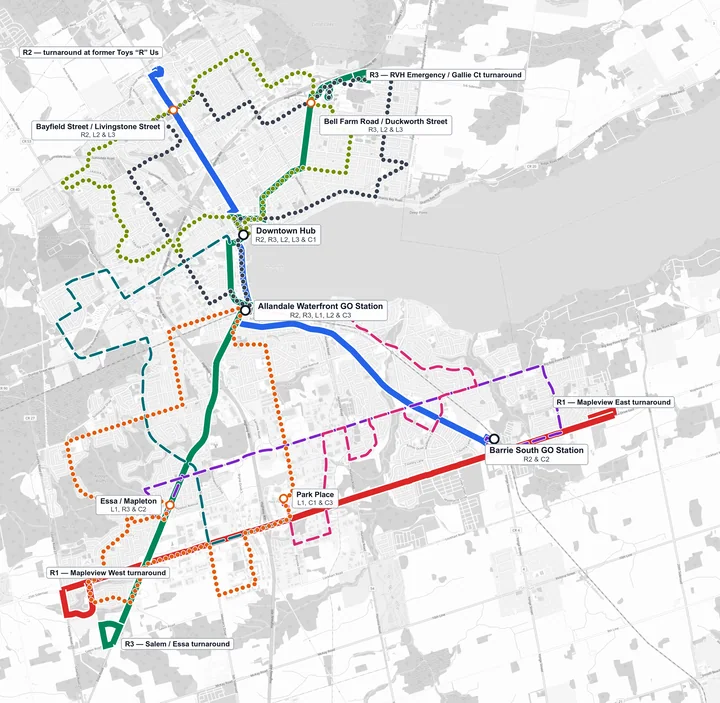
After looking closely at Barrie’s geography, existing transit routes, published schedules and feedback from residents, I identified three Rapid Lines along major corridors that should form the backbone of a more direct network:
- R1 Mapleview Crosstown would give south Barrie an east-west connection between southwest neighbourhoods, Park Place, the Barrie South GO area and growing communities in the east.
- R2 Barrie South GO Station–Downtown–Bayfield would connect Barrie South GO with Allandale Waterfront GO, Downtown and the Bayfield corridor.
- R3 Essa–Downtown–Georgian College–RVH would connect the Essa corridor with Allandale Waterfront GO, Downtown, Georgian College and RVH.
These Rapid Lines would follow major corridors instead of turning through every residential area. Their purpose is to help riders cross Barrie faster and make the network easier to understand.
Local service would remain essential. Three bidirectional Loop Lines would circulate through the areas between the main corridors, allowing riders to take the shorter direction around each loop. Three Connector Lines would link neighbourhoods, schools and employment areas to the Rapid and Loop network.
Together, the three service types would serve different needs. Rapid Lines would carry cross-city trips. Loop and Connector Lines would provide local access and connect with the main corridors at several points.
The map is a concept for public discussion. An operational feasibility study and public consultation must determine exact stops, turning movements, terminal locations, accessibility work and realistic running times.
Frequent service would make the network usable
A transit line on a map has limited value if the bus comes too rarely. The proposal therefore sets clear frequency standards for weekdays, evenings and weekends:
| Service | Weekday peak | Weekday daytime | Saturday | Evening and Sunday |
|---|---|---|---|---|
| Rapid Lines | 10 minutes | 15 minutes | 15–20 minutes | 20 minutes |
| Loop Lines | 20 minutes each direction | 30 minutes each direction | 30 minutes each direction | 30 minutes each direction |
| Connector Lines | 20 minutes | 30 minutes | 30 minutes | 30 minutes |
Weekend service matters because people still work, study, shop and keep appointments on Saturdays and Sundays.
On the Rapid Lines, missing one bus should not mean a long wait for the next one. More frequent service would also make transfers easier and everyday trips more dependable.
How the estimate reaches 81 buses
The fleet estimate begins with the proposed cycle time and peak frequency of each route. Dividing the cycle time by the scheduled interval gives the number of buses needed, rounded up when the calculation produces part of a bus. Under the preliminary assumptions, the three Rapid Lines require 30 buses, the three bidirectional Loop Lines require 22, and the three Connector Lines require 15. That is 67 buses in peak service.
Some buses will always be unavailable because of inspections, cleaning, scheduled maintenance, breakdowns, collision repairs or equipment problems. The proposal applies a 20 percent planning allowance to the peak requirement. Twenty percent of 67 is 13.4, which rounds up to 14 spare buses.
The eventual purchase requirement could change after the City confirms route running times, the condition and planned retirement of existing buses, and the appropriate spare ratio. That analysis should refine the estimate rather than avoid the question.
What the network requires
More buses are only one part of making this network work. Barrie would also need:
- Enough operators, maintenance staff and supervisors to keep the additional service running.
- More garage, storage, maintenance and charging or fuelling capacity.
- Accessible stops, safe places to transfer and transit-signal priority along major corridors.
- A phased implementation plan that accounts for staffing, construction, vehicle delivery times and available provincial and federal support.
A credible cost estimate can only be prepared after the City confirms the types of buses required, facility needs, staffing levels and annual service hours. Those figures should be made public through the feasibility study and implementation plan.
An expansion of this scale would depend on substantial provincial and federal support. I would pursue a multi-year funding partnership with Ontario and the Government of Canada for buses, facilities, accessible stops and transit-priority improvements.
The network could be introduced in phases, but each phase should move Barrie toward the same goal: a simple network with direct routes and dependable service throughout the week.
What I would ask Council to do
I do not expect Council to approve an 81-bus network based on a campaign proposal alone. If elected, I would ask Council to take the next practical step: have City staff test the proposal properly and report the findings publicly.
Specifically, City staff should:
- Test the proposed routes, service frequencies and 81-bus fleet estimate.
- Hear directly from riders, transit workers, accessibility users, employers and residents across Barrie.
- Develop a phased plan showing the costs, staffing requirements and provincial and federal funding opportunities.
- Report publicly on whether the resulting service is reliable, frequent and meeting riders’ needs.
The map will change as transit professionals and residents examine it. What should not be lost is the goal: direct Rapid Lines, useful local connections and service frequent enough for everyday trips.
A practical alternative for more Barrie residents
Barrie cannot manage growth by expecting every additional trip to be made in another car. Roads will remain essential, but public transit should give more residents a dependable alternative.
The Barrie Rapid Network is a starting point: three direct Rapid Lines, supporting Loop and Connector Lines, and frequent service throughout the week. The next step is to test the proposal professionally, consult the public and turn the results into a practical implementation plan.
If you use Barrie Transit, work in transit or rely on Uber, Lyft or family members because the current service does not meet your needs, please share your experience through the campaign contact page. I want to know which trips take too long, which connections fail and where this proposal should be improved.
The Barrie Rapid Network is an independent campaign proposal by Georgy Kapustin, candidate for Barrie City Council in Ward 10. It has not been approved by the City of Barrie and does not imply City endorsement.
Sources
- City of Barrie 2026 Operating Budget - Access Barrie Transit and Parking Strategy, pp. 42-43, reporting the City’s conventional fleet and seven-day service.
- City of Barrie 2026 Budget and Financial Overview, reporting approximately 190,000 transit vehicle in-service hours and 30-minute peak frequencies.
- Barrie Transit Route 8B timetable, showing 30-minute weekday and Saturday service and 60-minute Sunday service.